
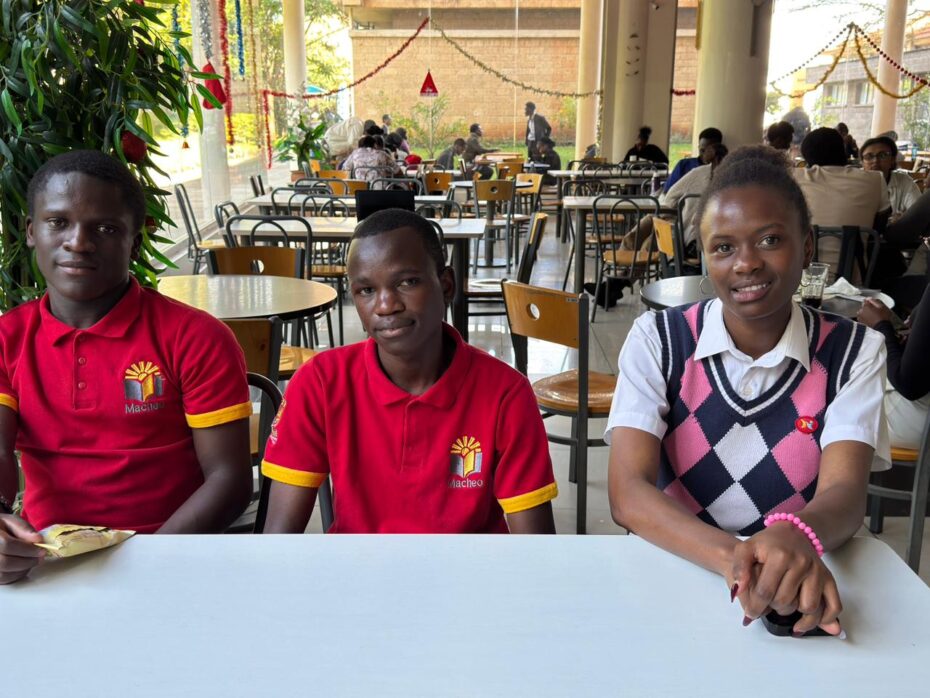
ACI has been providing support to the various Scholarship Programs of Strathmore Educational Trust (SERT) since 2005. For information on how to contribute to ACI’s Macheo Project, please see the note at the end of this article.
Macheo is a program founded by the faculty of Strathmore University in Kenya. Its goal is to give academic support and life skills to young teenagers who live in the slums of Nairobi. This program has been helping inner-city youths finish high school and move on to college on full scholarships since 2012. For these students, Macheo – which means sunrise in Swahili – is a lifeline out of poverty.
It is Saturday morning in Kibera, the largest slum in Africa. Located on the outskirts of Nairobi, Kenya, this densely populated area of corrugated shacks, mud and concrete is home for up to 250,000 people.
A few neatly-dressed teenagers begin to walk to Macheo; a mentoring program held at Strathmore University – one of Nairobi’s best universities. The program focuses on academic support, life-skills and character-building sessions.
For these students, Macheo – which means sunrise in Swahili – is a lifeline out of poverty. The long walk is more than worth it.
The History of Macheo
Macheo was founded in 2012 and modeled after a program in Chicago called Midtown Metro Achievement Center. That program has a successful track record of helping inner-city youths finish high school and move on to college. A group of Strathmore faculty heard about it and wanted to do something similar in Nairobi.
“Macheo students come every Saturday. They need to come during the day, because once it gets dark, there is a problem of security here,” said Luis Borrallo, director of Macheo.
The Macheo program runs every Saturday throughout the academic year, from 12:30pm to 5:30pm. It is a three-year program for students in their second, third and fourth year of high school. Macheo organizers prefer for students to enter when they are 15 and stay for three years. In some rare instances, students join in their 3rd or 4th year of high school, when a spot opens up.
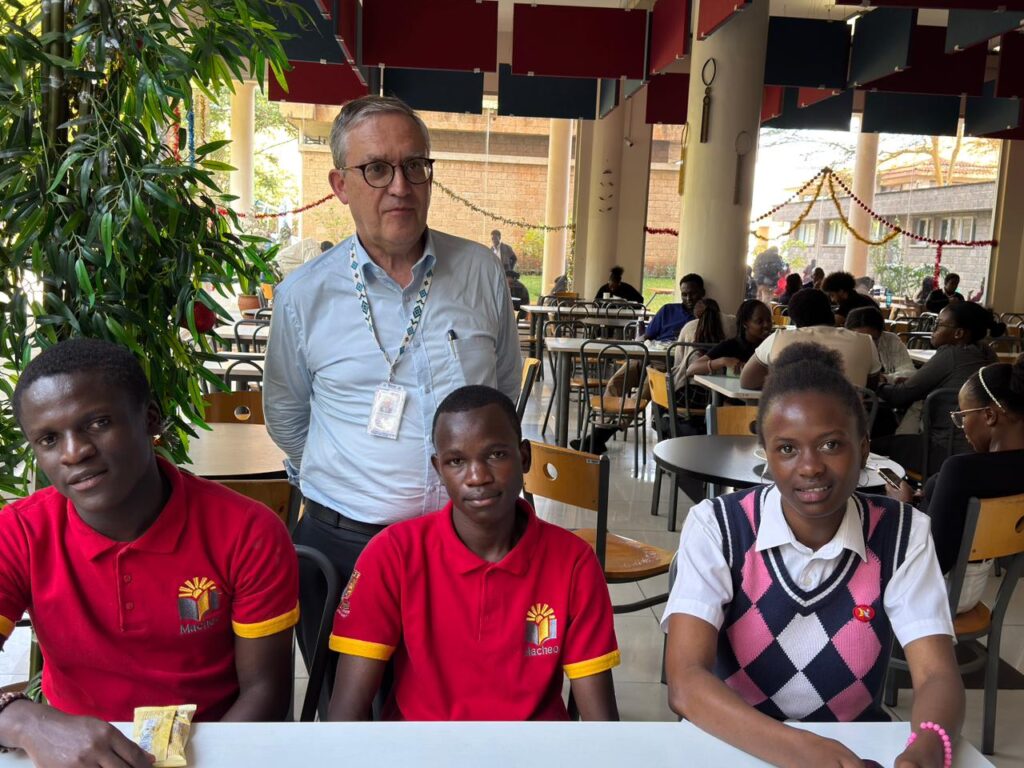
There are three cohorts in Macheo of around 50 students per grade, with 150 students in total. 60% of the students are girls.
The organizers of Macheo realize the effort these students need to make, especially after a full week of school.
“It is truly heroic,” said Borrallo. “But if they are to succeed, they need to do this. These kids are not lazy.”
Macheo does not advertise the program. Instead, the Macheo staff approaches eight high schools every January that are located in three slums of Nairobi: Kibera, Mukuru, and Kangemi.
“We ask for the names of the top performers who are 14 to 15 years of age. We ask for their report cards from the last year. We then conduct English and Math exams for these kids and then do personal interviews. Out of the top 20 students, we will pick 7,” said Borrallo.
The Macheo program is located on the Strathmore University campus. For most students, it is their first time seeing a place with beautiful, clean buildings and manicured lawns.
The program offers them free lunch before every session. Students are expected to pay $7 per year, as a way to have some ownership in the program and personal accountability.
Focusing on the Academics
Macheo teaches 6 subjects: math, physics, chemistry, biology, English and Swahili. Strathmore pays professional teachers to teach the kids.
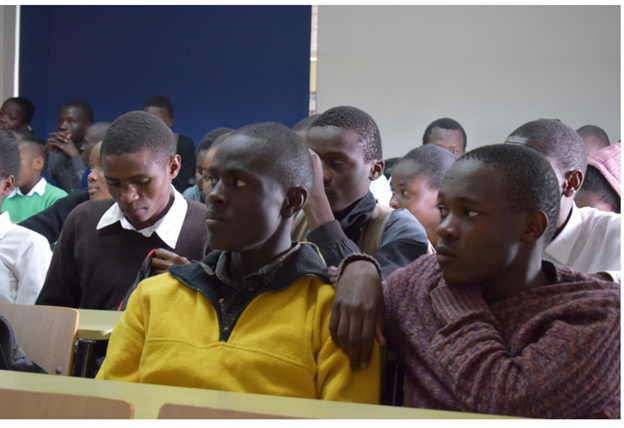
“Not all the subjects are covered every Saturday,” said Borrallo. “Part of the problem we find is that these high schools are not all moving at the same pace. Not all of their high school teachers are proficient,” said Borrallo.
One of the benefits that Macheo kids have is that they can use Strathmore’s laboratories, something that not every high school has.
“We give each student notebooks and they can access our library to borrow books,” said Borrallo. “Sometimes, if we have extra money, we will buy books for these high schools located in the slums, or lab equipment or even a computer.”
Transforming Lives
Sharon Mwashi is a 19-year-old woman in her 2nd year of studies at Strathmore University. She is on a full scholarship with plans to major in finance. Mwashi grew up in Kibera and joined Macheo during her Form 2 (sophomore year of high school).
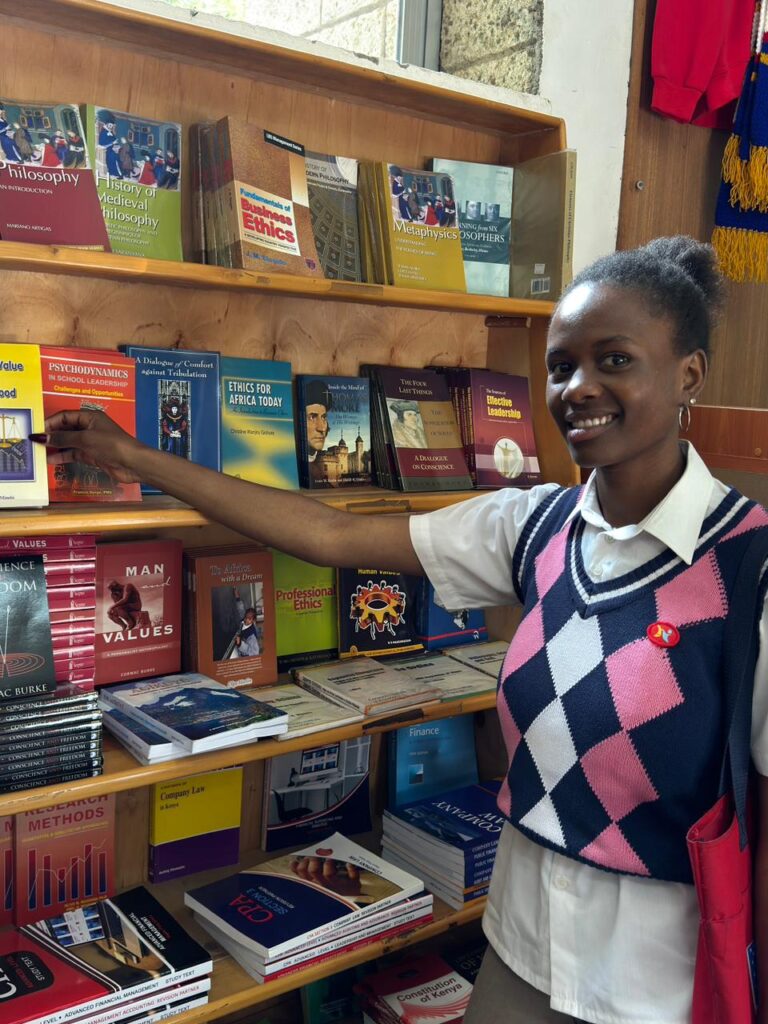
“Macheo made me who I am today,” said Mwashi. “Before I joined, I did not have confidence in myself to speak in front of people and interact with others. But through Macheo, I gained confidence. It shaped my discipline.”
Twelib Esmen is an 18-year-old who has been a part of Macheo for three years.
“This experience has been very impactful. We have teachers from the best schools teaching us. They give us classes and exams. We have group discussions and work on group projects, which helps to build togetherness,” said Esmen.
The Macheo program brings the students on excursions to Nairobi so that they can experience places and situations they have never seen before. The program also organizes some sports activities.
Learning about Character
The most important aspect of Macheo’s curriculum are the classes on character development. Every week, there is a one-hour session on character and life-skills. Normally it is given by university students or recent graduates.
The Macheo students take a comprehensive values education program called “Alive to the World”, which is written in the form of stories for different age groups.
“We get the kids to have a group discussion on different topics. The teens are then asked to make presentations in front of the others for 2-3 minutes. This helps them internalize the lessons. We present role models to them,” said Borrallo.
“We are taught how to engage with other people and how to conduct ourselves. This has really helped me,” said Joel Arieli, a 19–year-old high school senior in the Macheo program. “For example, we are asked questions and need to answer in front of the class. This is an opportunity to really explain what we think is right.”
Macheo’s Mentoring System
Macheo uses a mentoring system which pairs each student with a university student. About 50 university students volunteer with Macheo every year.
“Many of our mentors were once kids in the Macheo program. Up to 70% of them become mentors. It is very powerful when the mentor can tell the student, ‘I was in your school’,” said Borrallo.
The students meet with their mentors once a month, though they can meet even more times, if so desired. Anything that is shared is confidential.
“When I was in high school, life was not so easy. I was in a constant struggle,” said Mwashi. “But on Saturdays – during Macheo – there was always someone to talk to. My mentor gave me hope and encouraged me. She helped me to face life with courage.”
About 70%-80% of the Macheo kids come from broken homes, where fathers have abandoned the family. There is a high rate of divorce and single mothers in the slums.
“Some of the kids have one parent with AIDS. It is not unusual for their mothers to make money by selling vegetables, and have three to four children at home,” said Fred Odhiambo, English and literature teacher at Macheo.
Believing that Success is Possible
During the last 13 years, between 60 to 70 Macheo participants have gone on to study at Strathmore University. Ten of them are now working as employees of the university.
One of the biggest hurdles that Macheo needs to overcome is to get these teenagers to believe that they can succeed in life.
“Some don’t believe it. The gap between what they are living and what they dream is too big. I don’t blame them,” said Borrallo.
This was Joel Arieli’s reality. Prior to joining Macheo, he never considered that university was even a possibility.
“Macheo really exposed me to the real world. During my elementary school years, I would have said that I could never afford university. But Macheo has showed me how you can secure a scholarship,” said Arieli.
Macheo holds a “Career Day” in January, so that students can get a chance to meet and speak with professionals in different fields.
“We have people explain what the different options are to study and the different careers that they can do,” said Borrallo.
One of the teachers who has been with the program since the beginning is Odhiambo. He knows the reality that these teenagers face at home.
“I remember that once, we visited the slums with a social worker. One of our students was living in a one-room house that was 10 feet by 10 feet. The parents and the children were all sleeping together, in one room. When we wanted to sit down, there were no chairs – only old empty water jugs,” said Odhiambo.
Another problem is that men in the slums try to take advantage of the teenage girls. “There is something here called ‘period poverty’. This is where a man will tell a teenage girl that he will buy her sanitary pads, if she will sleep with him,” he said. Because of this, Macheo – quietly and discreetly – will sometimes have the mentors buy these items for the female participants.
Another way that Macheo tries to support the students in their program is to send each student to the university health clinic for a check-up before the program starts. During the year, the students can go to the health clinic for any reason.
“Most of the time, the matters are not very serious. Some students need glasses or a dentist. In other cases, we have done fundraising to help one of the students have an operation,” said Borrallo.
Though Macheo is not a religious program, participants can take part in one mass during the year to celebrate the feast day of St. Josemaria Escriva, who inspired and encouraged the founders of Strathmore University.
“Another spiritual aspect is that before exams, we ask a priest to pray for the students. They like this. Some mentors may bring up religious faith in private conversations,” said Borrallo.
Learning to Dream
Every Macheo student dreams of going to college and getting a full scholarship to pay for it. They hope to make a difference in Kenya and eventually help poor teenagers like themselves. Each, in their own way, is a walking miracle.
“My dream is to get good grades and get into a good university. I hope I can get a bachelor’s in computer science and then one day work in the market,” said Esmen. “And then, I want to do what Macheo is doing.”
Joel Arieli wants to study engineering. He is undecided between electrical engineering and mechanical engineering.
“But Macheo has given me the confidence and courage that I can do well on my exams and enter university,” he said.
“I would like to finish my studies,” said Mwashi, “and then become independent and then give back to the community. I would like to help children who face the same challenges as me.”
The organizers of Macheo like to say: talent is distributed evenly around the world, but opportunity is not. The Macheo program is trying to level the playing field so as to give young people from Nairobi’s slums a fighting chance.
How to contribute:
-
By Check payable to “ACI, Inc.”, memo: “SERT Scholarship Program (MACHEO)”, and mailed to
Association for Cultural Interchange, Inc.
420 Lexington Avenue, Suite 300
New York, NY 10170
-
Or Email us at [email protected] for instructions about sending a wire transfer or other forms of payment.