
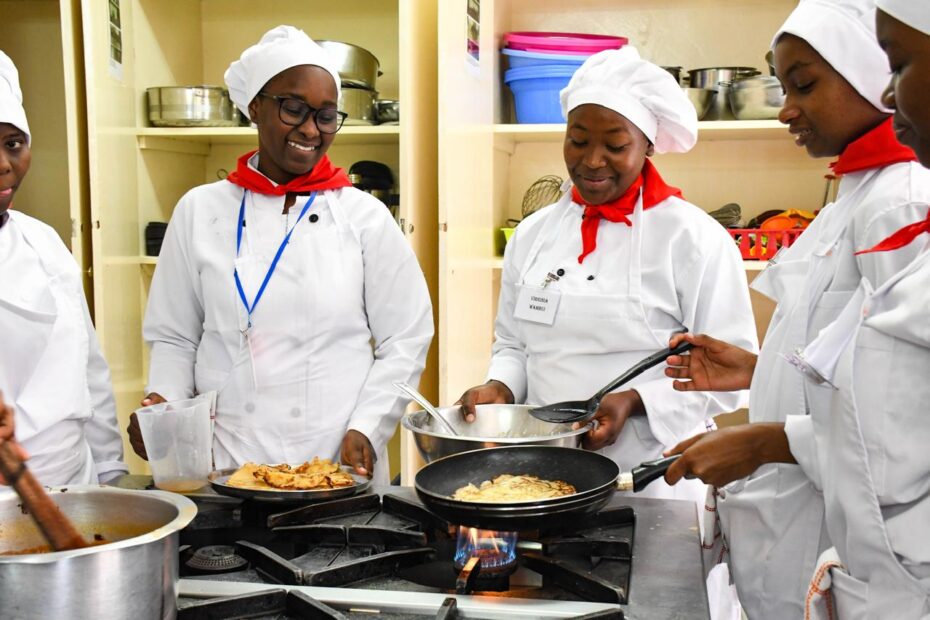
Since 2016, ACI has made grants of more than $50,000 to the Kianda Foundation for the Kimlea Girls’ Technical Training Centre. For information on how to contribute to ACI’s Kimlea Project, please see the note at the end of this article.
Kimlea is a hospitality school in Kiambu County, Kenya. It offers classes in the different areas of hospitality: housekeeping, laundry, food and beverage production and service. Since its inception, Kimlea has taught over 3000 girls, and in the process it has pulled all of them and their families out of poverty. These young women are now chefs, entrepreneurs, hotel managers, and community leaders.
Few girls who grow up in Kiambu County, Kenya, are exposed to opportunities that help them dream big.
This largely rural area, about 45 minutes’ drive outside of Nairobi, is surrounded by tea plantations. This is why the Kimlea Girls Technical Training Centre plays such a powerful role in expanding horizons, building confidence and empowering young women to discover their potential and pursue ambitious goals.
“In that area, you find the poorest of people. They work on tea plantations, which is very tiring, ha and poorly paid. When these families have children, they will often grow up to do the same thing,” said Mercedes Otaduy, CEO of the Kianda Foundation, an organization dedicated to women’s education in Kenya. “The parents can barely feed their children.”
In 1992, Kianda’s leadership decided to start a technical training college in Kiambu with various courses. Eventually, it was streamed-lined to focus on hospitality courses as they realized that when girls became involved in hospitality – and especially catering – it led to better jobs.
“Kenya has a lot of tourism and so there are many jobs in this field: house-cleaning, laundry and cooking,” said Otaduy.
Little did they know how far this dream would go. Today, the Kimlea Girls Technical Training Centre has become a feeder school for some of the best hotels and restaurants in the country. It has lifted scores of women and their families out of poverty – and given them a self-confidence they could never have imagined.
In fact, as General Manager Stephen Mugo of Limuru Country Club stated, “Kimlea students are the Mercedes Benz of the hospitality industry!”
Land of Dreams…for Some
Kenya, with a population of 55.4 million people, has the largest economy in the region of East and Central Africa. According to Statista, Kenya had a per-capita Gross National Product (GNP) of US $2,274.95 in 2024. Agriculture is the largest economic sector; with tea and coffee as traditional cash crops, while fresh flowers are a fast-growing export.
One of the major economic drivers is the service industry, especially tourism. Kenya receives 2.4 million foreign visitors every year who are interested in going to the country’s beaches as well as game reserves.
Despite these economic factors, poverty measured as an income of $3.00 a day was projected to affect 43.8 percent of the Kenyan population in 2025 by the World Bank.
The History of Kimlea
The Kianda Foundation established a successful hospitality school in 1967 in Nairobi called Kibondeni.
“We realized that many girls from poor backgrounds needed to acquire some skills. We thought that these skills in hospitality would be beneficial. And we had lots of success. Our girls began to get jobs in hotels,” said Otaduy.
“With that experience we started Kimlea in a pre-fabricated room in 1987 with a small group of women from the tea plantations” she said. “Soon these women asked us to have some courses for their daughters, and in 1992, the Kimlea Girls’ Technical Training Centre was launched with the young girls in mind.”
Today, Kimlea is a day school that offers classes in the different facets of hospitality: housekeeping, laundry, food and beverage production and service. Supporting subjects include: nutrition, front office, entrepreneurial skills, ICT (information and communications technology), life skills and personal development.
There are 114 students in the school. Over 3,000 girls have benefitted from Kimlea’s program since its inception. They are now chefs, entrepreneurs, hotel managers, and community leaders.
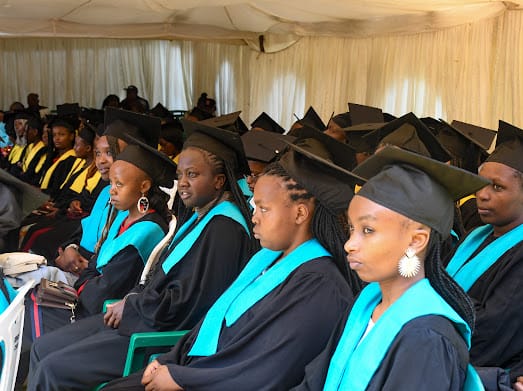
The program at Kimlea used to be two years long. However, the Kenyan government recently recommended shorter courses to concentrate the program into one-year. The girls who go there receive a certificate in hospitality upon graduation.
“During the first term, we give them thorough classes in hospitality. During the second term, we begin to send them to hotels for three days a week, while the other three days are in the classroom. During the third term, the girls prepare for exams,” said Peris Gichuki, deputy principal for Kimlea.

“We try to be very practical in how we teach. It is very hands-on,” said Otaduy.
Mentoring Each Student
One of the most important aspects of the Kimlea education is the concept of personal accompaniment for each student.
“Many girls come here with very low self-esteem. We get them to discover themselves. What we see is that after one year, the girls gain confidence. It is a beautiful transformation,” said Otaduy.
Each girl gets a personal mentor from the first day. They can meet with the mentor twice a month, or more if needed.
“We always ask the girls towards the end of the program to write about their impression of their first day at Kimlea. What they always write is that they are so amazed at seeing such clean kitchens, and how people are so kind,” said Otaduy.
The students are given increasing responsibilities to gain confidence in themselves.
“When we have visitors come to the school, we ask the girls to show the visitors around and talk about the school. We want to show them that they can do this,” said Otaduy.
The average student is between the ages of 18 to 25. They are high school graduates, with no money to go to college.
“Most of our girls have a full scholarship, though we ask them to pay something – a nominal fee. Others pay a small percentage. This allows them to feel that they have contributed something to their own education,” said Otaduy. “It is a holistic education. We want to make them successful professionally.”
A New Life for Struggling Teens
Peris has been at Kimlea for 23 years and is the second-in-command at the school. She knows perfectly well what life is like for the girls who come here. This is because, when she was a teenager, her family went through an extreme financial crisis.
In fact, by the time Peris had finished high school in 1998, she felt she had reached the end of her rope.
“After the tribal clashes of 1992 in Kenya, my family had to move out of the Rift Valley. It was very difficult. My parents, who had 6 children, lost everything: their property and their jobs,” said Peris.
With tremendous difficulty, Peris was able to finish high school – but after graduation, she did not know what to do and had lost all hope. Then someone in her village suggested she go to Kimlea.
“Luckily, Kimlea charged almost nothing, so I went. I studied at Kimlea for two years,” said Peris. “They were charging $1 per month. But even if you could not come up with these fees, they never charged us.”
Soon after graduating from Kimlea, Peris was hired as an assistant teacher at Kimlea. With the money that she made, she was able to pay the fees for her siblings to get through high school. During this time, Peris was also able to go to Technical University of Kenya for evening and holiday classes; and get her certificate in hospitality. After this, she continued with her studies and eventually earned a diploma in business management and later on, a bachelor’s in business administration and management from St. Paul’s University. Peris did all of this while working at Kimlea, getting married and raising five children.
“Since the beginning, Kimlea has worked to help break the chain of poverty for girls from the tea plantations. It has really transformed this community,” said Peris. “I have come to learn that every girl just needs somebody to give her a chance to be who she can be.”
For her, the chance to work at Kimlea has also been an opportunity to give back.
“Kimlea is more than a home for me,” said Peris. “Every time I have students who are very poor, I always want to listen to them. I tell the girls that I feel very empowered to be the deputy principal. When these girls see me, they have hope.”
Spending time with the girls, one-on-one, is one of the most important parts of Peris’s job.
“I always have a chance to be with the students one-on-one, especially those who are despairing. I try to make them understand that their situation is very temporary, and in a short while, they will cross the bridge,” she said.
The Kimlea Difference for Employers
Stephen Mugo knows first-hand how hard the Kimlea students work.
“Several years ago, we came to an arrangement with Kimlea for their students to come to Limuru Country Club for their internships,” he said.
During the two years that he has been at Limuru, he can see an immediate difference between Kimlea-trained women and those from other places.
“The Kimlea students are disciplined. They come to work on time and are never absent. Wherever they work, everything is clean,” he said. “They are also very well prepared technically.”
Mugo has also been impressed with their professionalism. The Kimlea women always have positive interactions with the club members.
“They always maintain a proper etiquette. When I compare them with women from other institutions, they really stand out,” he said.
Mugo notes that the members of his club come from the top 10% of Kenya’s society.
“The Kimlea girls come from very humble backgrounds. You might expect that this could cause trouble. But they always carry themselves professionally,” he said.
Learning the Trade and Life Skills
Margaret Kariithi, a 22-year-old, is studying at Kimlea this year. Her favorite classes are Food and Beverage production and service as well as Front Office.
“I also love to make pastries,” she says with a smile.
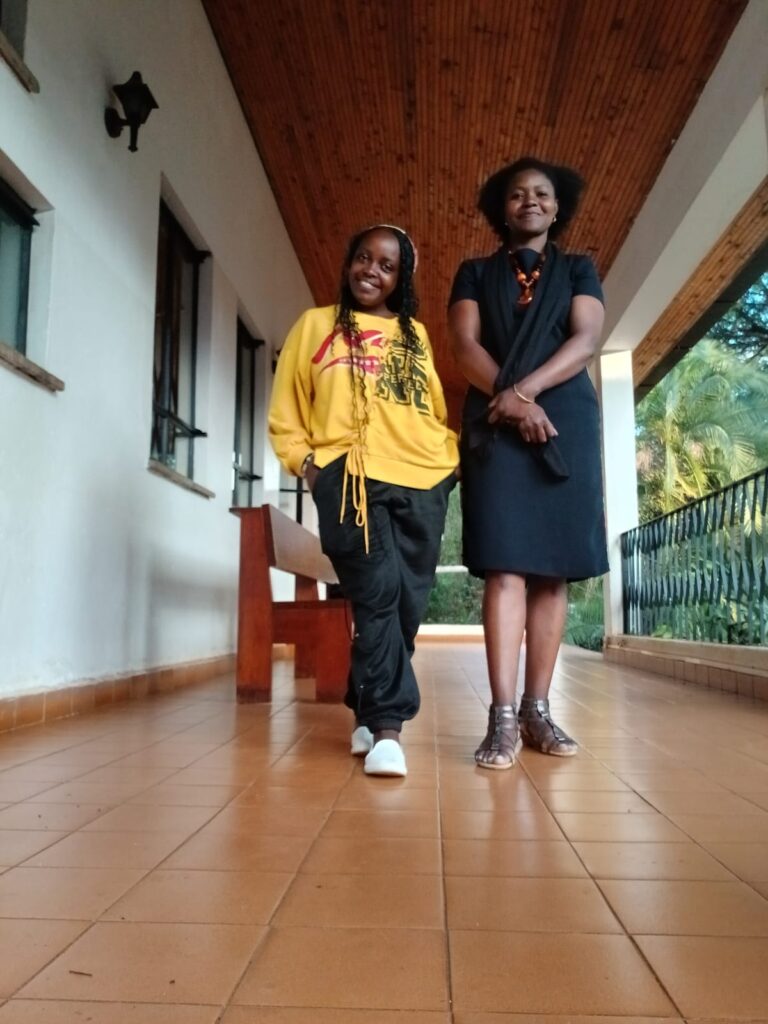
Kariithi appreciates that fact that Kimlea works to teach the students about virtues and life skills.
“We talk about virtues and how to interact with people, how to behave, how to talk to others. I have learned a lot,” said Kariithi.
One of the aspects about Kimlea that gives her a great deal of hope is that every girl who graduates finds work in good restaurants or hotels.
“The graduates visit us and tell us about the industry,” said Kariithi. “You can see that they are doing something good with their lives.”
When Ann Faith Nyakio, aged 20, began studying at Kimlea, she was pleasantly surprised with how kind everyone was with her.
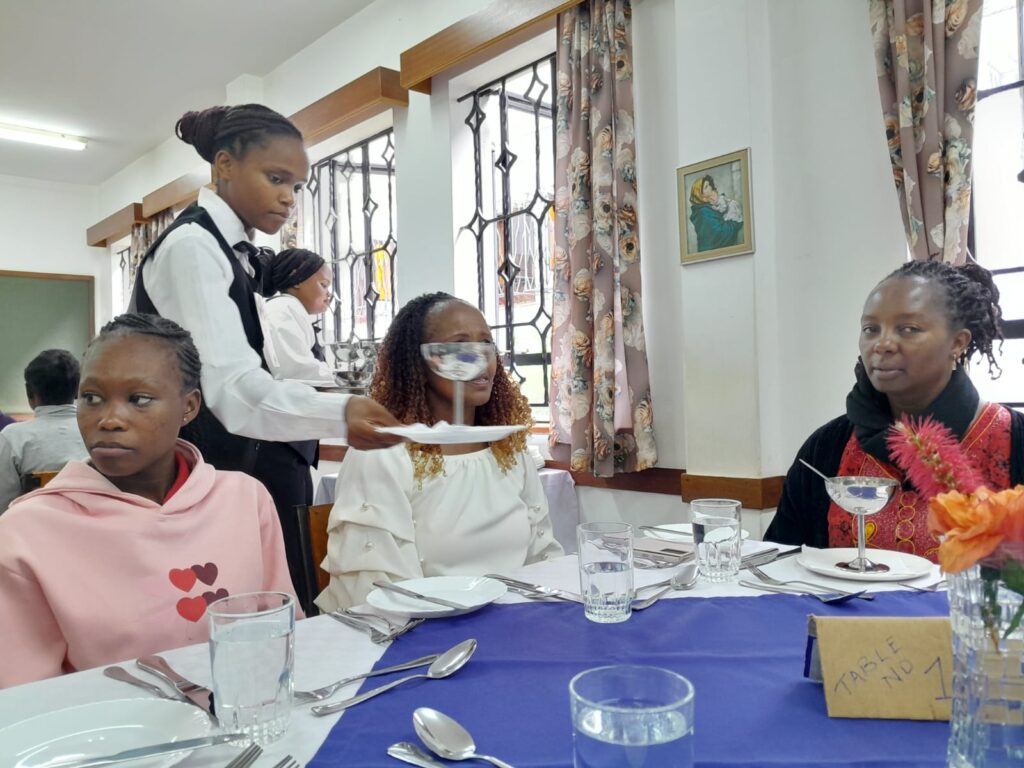
“They took me in as a daughter,” said Nyakio.
Her favorite classes are Housekeeping, Laundry and Catering Premises.
“We learn about how a premise should look like,” said Nyakio.
The Spiritual Side of Kimlea
All the girls at Kimlea receive classes on ethics. Though Kimlea is a school of Catholic inspiration, girls of any religion can attend. Catholic mass and the sacraments are available at Kimlea’s 1chapel for any girls who want it.
“The girls do appreciate the spiritual side of our curriculum. There are more Protestant girls here than Catholic, and a few Muslim girls. A priest is available here for any girl who wants to go to confession,” said Otaduy.
Because the students all come from very poor families, they suffer from many problems.
“When a family has severe financial difficulties, there are lots of disagreements and quarrels in the home. Most of the families are run by single mothers. The men have either abandoned them or divorced them. Because of this, the girls suffer tremendously. And they worry a lot,” said Otaduy.
Otaduy remembers one conversation she had with a student who lived with her single mom.
“What is your dream? I asked her. And she said, ‘My dream is to build a house of stone for my mother’,” said Otaduy.
Life After Graduation
The best part about Kimlea is that as soon as the girls graduate, it is not difficult for them to find good jobs.
“Industry loves our girls,” said Peris. “This makes them shine. Our girls have gotten jobs in the best hotels in the country. Some of our girls will go on to study more. We encourage all of them to work and continue their education.”
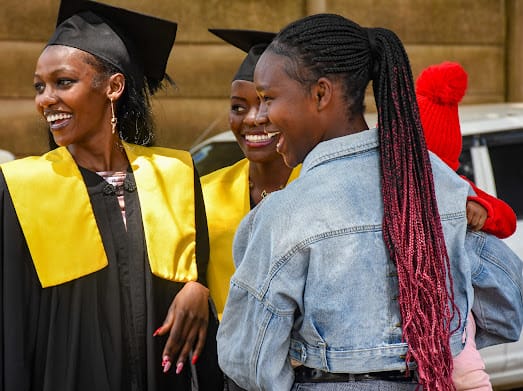
Though dreams often die for those living on tea plantations, within Kimlea’s walls, they seem to come to fruition.
“Now I see myself with a bright future. My dream is to own my own restaurant.” said Nyakio.
Within the nurturing walls of Kimlea, nobody laughs at her dreams.
With the support of those around her, the sky is the limit.
How to contribute:
-
By Check payable to “ACI, Inc.” with memo: “Kianda Foundation (Kimlea)”, and mailed to
Association for Cultural Interchange, Inc.
420 Lexington Avenue, Suite 300
New York, NY 10170
-
Or Email us at [email protected] for instructions about sending a wire transfer or other forms of payment.